Should You Trust AI With Medical Advice?


ChatGPT just launched a medical advice tool, and doctors are divided on whether AI should diagnose your symptoms before a real physician does.
You already Google your symptoms. You already use AI when you can't afford the vet bill or can't get a same-day appointment. The question isn't whether people will use AI for medical advice—they already are. The question is whether it's safe, useful, or just another liability trap.
- Why rural hospital closures are forcing people toward AI healthcare — and what happens when your only doctor is a chatbot
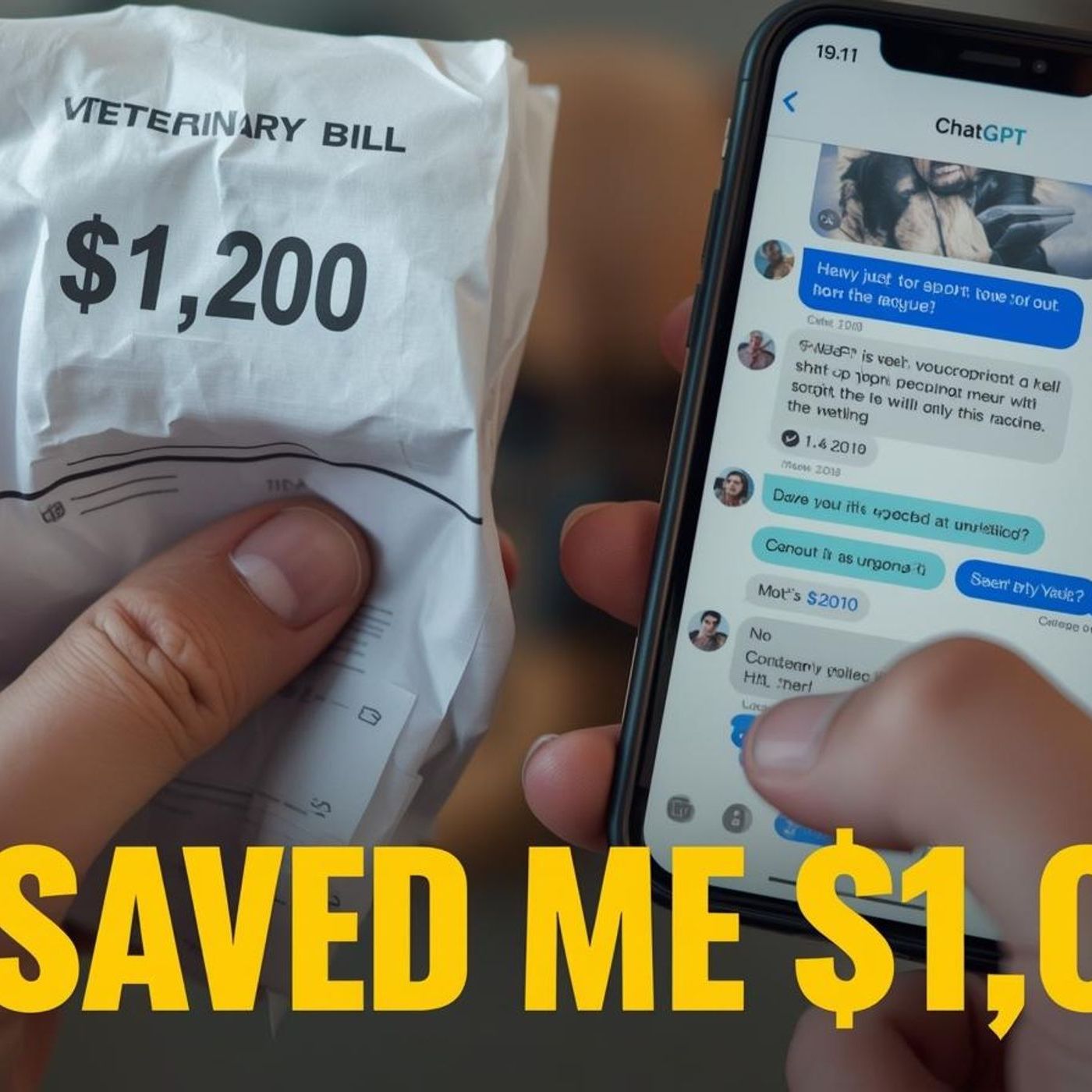
- How for-profit medicine creates the same "get you off our doorstep" incentive that vetted Jeremy's dog with a $1,200 estimate for throwing up
- What AI gets right about medical triage — and where it dangerously homogenizes care into actuarial charts
- When asking better questions matters more than getting perfect answers — and how AI can arm you to challenge bad diagnoses
- Why privacy advocates warn against giving medical data to AI companies — and what happens when insurance companies start buying access
- What happens when Docbot calls Lawbot — and you're left holding the liability
This is The BroBots: two skeptical nerds stress-testing AI's real-world implications. We're not selling you on the future. We're helping you navigate it without getting screwed.
Chapters:
0:00 — Intro: ChatGPT's New Medical Tool
2:15 — Why Rural Hospitals Are Closing and AI Is Filling the Gap
6:43 — The $1,200 Vet Bill ChatGPT Helped Me Avoid
13:35 — How AI Homogenizes Care and Kills Medical Unicorns
17:50 — The Liability Problem: When Docbot Calls Lawbot
21:16 — Final Take: Use It Carefully, Own Your Health
Safety/Disclaimer Note:
This episode discusses AI medical advice tools and personal experiences. It is not medical advice. Always consult a licensed healthcare professional for medical decisions.
Jeremy Grater (00:00.462)
We're recording, recording. Okay.
Jeremy Grater (00:10.19)
All right. Hey, welcome to robots. This is the podcast that tries to help you use technology to be a better human. This is something that we have talked about a number of times. But today I want to talk about this tech crunch article where they say doctors think AI has a place in health care. Just maybe not as a chat bot. This is all tied to the idea that chat that chat GPT is now building a tool that is specifically designed to help you with your medical questions. They are sort of acknowledging that people are doing this anyways. So why not try to do this in a safe way that they can
potentially put in the best guardrails to keep you safe and put you on a path to success when you cannot get to a doctor because in many cases there is quite a long wait. Jason, I know we've talked about this before, lots of concerns about this but maybe it's a helpful tool for a lot of folks.
Jason Haworth (00:56.807)
Well, so we have macro problems around our medical industry. So the for-profit health care system in the United States is very problematic. In the U.S., we pay three times the average of a world of our economic status compared to other folks. And because of that, when you start talking about small and rural hospitals, they're closing. And they're closing because they cannot keep up with the financial pressure to actually make money, to make them profitable, to actually get the
the revenue out of them that they need for them to stay open. So if you live in a rural town way back in the day, it was very hard to get internet access. So in 1996, the Clinton administration came out with the 1996 Communications Act, which basically said everyone's supposed to have equal access to communication technologies, which included the internet. So it's now 2026, 30 years later, most people have access to the internet.
Jeremy Grater (01:54.764)
Mm-hmm.
Jason Haworth (01:55.521)
And back in 1996, most people also had access to a doctor before they had access to internet. Well, we flipped those. And because we flipped those, the medium for you to actually be able to get health care has become the internet for lot of folks. And you'll see an adoption by a lot of the health care companies to move towards telehealth. And the reason why they move towards telehealth is because the rates that they pay those doctors and those hospitals
is lower for the telehealth communication than it is for the infrastructure portion of it because they don't have to rent space and they don't have to pay physical bodies to check you in and do your vitals and all those other things. They're just going to kind of go, eh, it's kind of like this. It's a level of care that's not quite as good, but it's better than the nothing that they probably have access to or having to drive four hours to get to a hospital. So the need for medical technology to be virtualized and brought to you has shown up.
as a result, at least in the US, of the way that we've changed our financial patterns. And because of that, if you look at the way that we're actually trying to implement these components, we're going to try to use the medium that we have. And the medium that we have is the internet. The next phase in that is to go, hey, instead of having a doctor that you check in and see your nurse that you tell your symptoms to, why don't you tell it to these agentic AI functions and they can collect the right amounts of information.
and then they can start using those things and incorporating those things into a larger overall health plan. Now, whether or not this chat GPT new agentic AI healthcare mechanism is actually a good thing, a bad thing, we don't know yet because we're going to experiment and play with it. It certainly can't be any worse than the fact that we've enabled people with WebMD because a Google search for these things quite often gets people panicking. If you guys have not watched the show, The Pit, it's in
entirely excellent to watch this show because it is really really good at showing patients that come in at least in a couple of episodes Well where you know the mom comes in trying to protect her son from having a spinal tap because she doesn't want him to have some Perceived 1 % chance of having some other issues later on down the line Because when you give information to stupid people they tend to do what they want with it and make stupid decisions and
Jason Haworth (04:17.253)
I don't know that ChatGPT is going to make any better version
Jeremy Grater (04:22.541)
I just lost your audio.
Can't hear you at all. There you go, I got you back now. Okay.
Jason Haworth (04:27.281)
You can't hear me at all. okay. I don't know if, if chat GBT is going to make this any better or not, but they're certainly not going to fuck it up anymore.
Jeremy Grater (04:37.025)
Yeah, and I think you're talking about the doctors requesting that people sort of run through these processes. People are doing this anyways. I just did this with my dog, and I'll tell you this little story.
Jason Haworth (04:43.44)
Right.
Jeremy Grater (04:47.661)
I was I had a dishwasher problem. I won't bore you with the details. But ultimately, as I was monkeying around with it, trying to figure out what was wrong with it, I popped loose some white chunk of something crusty hit the ground. I didn't think too much of it because I was going to clean it up when I was done monkeying around. Another device in the house went sideways. So I went to deal with that. And when I came back, I found my dog eating the white chunk of whatever it was. Now in my head, the closest thing I could assume was that some dishwasher tab had not fully dissolved and that he just ate it.
And if you've ever heard what happens to an animal that eats one of these, it typically doesn't end well. So I was very nervous and very worried about what this was possibly going to mean for his health. so I'm trying to figure this out. I'm trying to call any vet that can answer my questions. And they're all basically saying, yeah, come in. We'll take a look.
Okay, that doesn't help me, you know, right now with what to do you guys close in an hour. Anyways, lots of details. Ultimately, after trying to get on on a phone with the poison controller, somebody they convinced me to go to an overnight vet the whole time. I'm on chat GPT saying this is what happened. This is what I think it is. How serious is this and early on it was like, go to the vet dummy. What are you waiting for? Get get in the car.
And I was like, okay, yeah, let's let's do this. We're gonna go and so I go to the vet and the whole time I'm asking like, okay, it's been a couple of hours still no symptoms. Am I good? And it's advising me like, okay, that's promising. That's a good sign. Like, you're on the right track, but still get it checked out. I get to the vet. And pretty typical, I think of most medical visits when you don't really know what's up. They do the temperature check, the check his weight, look at his gums, listen to his heart.
The vet comes in and says, we don't really know what he ate. So our best option is to throw everything at it. We're going to make him throw up, we're going to pump charcoal in his stomach, we're going to do a blood test, we're going to do x rays, we're going to open him up and figure out what's it was like, my god, like, what what if he's fine? What what if what he ate is just like some mineral buildup, and it's harmless? Like, what's the big deal?
Jeremy Grater (06:43.499)
So he goes back to work up the estimate for what I'm about to pay. In the meantime, I'm saying the doctor wants to run blood work. The doctor wants to do this. He wants to make him throw up. But is this all good? And it's like, blood work is dumb. All it's going to tell you is if there was some pre-existing condition and it's going to establish a baseline. It's saying throwing up is a bad idea because this is a caustic material that if it burned anything on the way down, it's going to burn it on the way right back up.
So I'm getting all this medical advice. And so the doctor or the tech comes back in with the estimate of like twelve hundred dollars for this 13 year old dog that might have eaten something stupid. And so I just asked the questions that that I asked me to ask is like, is the blood work necessary? Is the vomiting a good idea? Blah, blah, blah. And the tech didn't know. So they went back into the back room, talked to the vet and came back with a form asking me to sign that I was agreeing to decline care. And
I wasn't I was just asking questions and they were like, if you're gonna ask questions, then we're not gonna treat and thanks so much for coming. Bye bye. So in the end, long story short took him and I said, look, I think we're going too far here. I'm gonna take him back home. If anything goes sideways, I'll come back and they're like, okay, your choice to see then and he was fine. Nothing ever came of it. Probably eight turned out to be nothing and I'm glad I didn't spend $1,200. I only paid the 150 bucks for the appointment to be told, you know that they weren't gonna treat him.
I didn't really think too much of it until I was having a conversation two days later with somebody who did the exact same thing. Their dog ate something stupid and they're on chat. He trying to figure out is my dog going to die? And I just thought, man, if the two of us in this small town are doing this, everybody's doing this.
Jason Haworth (08:22.139)
Yep. Well, the Canadian is. that's so weird. the Canadian veterinary system is a for profit system, much like the American health care system. So I think if you're a Canadian going to the vet, you're getting a taste of what it's like when humans go to the doctor in the US because they're just trying to get money out of you. And if you don't do what they say, then they'll say.
Jeremy Grater (08:27.062)
Just lost your audio again. Nope, now you're back.
Jeremy Grater (08:44.256)
Yep.
Jason Haworth (08:49.799)
Well, you're refusing to take our treatments. So here's a form for you to sign and get out. And that's problematic for a couple of reasons. And I don't think we necessarily want to go into full depth on that as much as it is. We want to talk about the practical utilization of being able to use a tool like this to query things about your health and the health of others. And pets are a great example of this because pets aren't protected by any kind of
Jeremy Grater (08:55.146)
Yeah.
Jason Haworth (09:18.301)
privacy laws. They're not protected by anything out there in terms of what data I hand over to them. Can it be exfiltrated? Is somebody going to take this and do identity theft of my dog Fido and open up a credit card in his name, which could probably happen. Right. But this is this is the interesting part about this. Privacy advocates in this regard would come out and tell you you shouldn't give these things this much information because they're
Jeremy Grater (09:33.846)
Sure.
Jason Haworth (09:46.875)
the people that make these tools are going to use them against you. And I guarantee you that with chat GPT rolling this out, they're going to market this to insurance companies and they're going to market this to state sponsored insurance companies or single payer systems because they're going to want to provide this level of access to have people make that make these decisions in a smarter, more controlled way. And there's a lot of economic incentive.
to move things in this direction because they perceive cost savings. And when you think about it, about 90 % of medicine is triage. Like it's, know, what are we gonna do next? Which route do you go? And most of them, the path they're trying to find is how the fuck do we get you off of our doorstep as quickly as possible? Not that we wanna treat you and care for you and take care of you, make you better. It's how do we make you go away without killing you in the process?
Jeremy Grater (10:34.188)
Yeah.
Jason Haworth (10:43.917)
And I hate to say it, but that's what it really comes down to. And there's lots of individual doctors and clinics and everything else out there that are really set up to want to be good providers and help you and do no harm and make you better. But the system is not set up for that. The medical system is set to be a conservant system to try to provide the minimum level of care to keep you people.
Jeremy Grater (11:12.292)
They're trying to turn it into McDonald's. They want as many cars driving through as quickly as possible, getting as many Big Macs as possible so that they can meet their bottom line.
Jason Haworth (11:20.017)
Yeah, McDonald's is a fair example. mean, some of them, depending which house you go to, maybe it's Starbucks, maybe it's White Castle, maybe it's fucking Wienerschnitzel. mean, there's different variation and levels of this, and they all have disparate, non-interconnected systems. And because they've got these things set up in this way, they need these kinds of abstraction layers to come in over the top to try to make them make sense, because...
If you look at like a hospital billing system from one hospital to the next, like in my town, we've we have three emergency rooms within 10 minutes from me. Well, maybe 15 minutes. And all three of them use different medical record systems. They use different billing systems, these different tracking systems. And every one of the health insurance companies has to figure out a way to incorporate in those pieces and make those pieces work. If you relied on those hospitals to come through.
and actually build an artificial intelligence agentic AI system to be able to do something realistic, you would get varying degrees and varying levels of success. And they wouldn't be able to interoperate with each other and they wouldn't be able to share. The beauty of having this system come in this way is that it can be shared and it can be used across these elements in these environments and it can be adopted. Which I keep going back to this notion that it's great that we have this abstraction technology.
It's scary as shit because it's going to homogenize these things into one view, which is definitely going to happen. And I haven't decided whether or not that's good or bad for society in general.
Jeremy Grater (12:56.714)
And but I but I don't know that that's terribly unique from the human experience because most of our medical professionals have gone through largely the same training and been told largely the same things. And if you went to most doctors like I see this happen all the time, people will go to multiple doctors for whatever is ailing them and they'll all get the same diagnosis. But there will be some fucking unicorn that they somebody went to one time that figured something out. That person sees things a little bit differently. And they're the ones that find the cure for the thing. So again, like, I feel like we have this conversation a lot where it's
like is this gonna turn into everybody sort of thinks the same thing? Everybody kind of already does, with the rare exceptions of the few people that see the world a little bit differently.
Jason Haworth (13:35.986)
But I think what this does is it rounds up all the unicorns and puts them in a pen and shoots them in the skull. Yes, because there's no reason for unicorns to exist anymore. Because if you've got this thing that works across the board and you want to set these things for standards of care and lock those people in and not give people the ability to wiggle their way through these different avenues and angles.
Jeremy Grater (13:43.019)
Really.
Jason Haworth (14:02.322)
The companies that are going to run these pieces are going to make that happen because they're going to turn these things into actuarial charts and predictable metric outcomes for economic incentives because that's what it's going to turn into.
Jeremy Grater (14:14.027)
Yeah, I still think that there will and this is maybe this is just me trying to find a glimmer of optimism and all this. I still think there will always be some need for a human, right? Like somebody is going to get that diagnosis from chat GPT over and over again and then whatever medical system is taking advantage of it is going to keep telling them the wrong thing. And then they're going to find the guy.
that the one person went to that has things that does things a little differently. He lives like it's 1998 and he has the solution. I think there will still be room for those people. Maybe there'll be less room and maybe there'll be less need because there won't be as many survivors of these problems that come up. But in the end, think this all this does for me is it arms me with the ability to find the questions I need to ask that I didn't know I needed to ask.
It gives me the information that I wouldn't otherwise know without going to what I've heard referred to for decades as Dr. Google, right? It just summarizes a lot of the other searches I was going to do. It just makes me a better patient so that when and if I am lucky enough to go to my doctor, I can say, that's not what I read. And I think that frustrates doctors who are trying to McDonaldize the system and get you out the door rather than talk to you for 20 minutes instead of five.
Jason Haworth (15:09.373)
Totally, yeah.
Jason Haworth (15:20.998)
Yes.
Jason Haworth (15:27.301)
Right, and when you replace the actual doctor with a chatbot...
We've done this experiment, right? Where we've gone through and we said, tell me what it means to be masculine. And we've given it all these different personas and all these different ways to say things. And they all pretty much came back with the same grouping of responses, even though the that we asked it to emulate are vastly different from each other and will probably have vastly different outputs. I think what will happen is the chat GPT doctor, the AI doctors,
Jeremy Grater (15:36.108)
yeah.
Jason Haworth (16:03.356)
will homogenize and I think those things will become that and you might very well be correct. There might be actual physical human doctors that you will go in and you will see who will look for different scenarios and different problems. But I think as they stop dealing with more and more patients directly and they start getting these after effects as people look through these pieces, I think their tolerance and their bedside manner will probably get worse.
Jeremy Grater (16:31.845)
That could be very true.
Jason Haworth (16:33.359)
I think their ability to find discerning information and look for things that might not follow a certain pattern are going to get worse because all of their diagnoses and everything they do is going to be tracked and monitored by the for-profit hospital systems and the insurance systems. And when they go too far off of the prescribed treatment plans, there will be a record of it and they'll get stomped for it. This will be a fascist takeover control of the medical system. It will.
And we're going to put AI in charge of it. And we're going to say, go for it, buddy. Tell us what we should be. And we're going to follow it because it's economically viable. And at the end of the day, if you need long-term protracted care on something today, your chances of getting it are low. And unless it's an acute disease, right, like something like cancer or some of the communicable infection piece, if you need something for a long period of time,
There is not great economic incentive to keep paying for you to keep you alive. And that's probably not gonna change. It's probably gonna get worse. It's probably gonna actually try to shuffle you off your mortal coil much faster. Because the people making the decisions don't give a fuck.
Jeremy Grater (17:34.773)
Yeah.
Jeremy Grater (17:49.301)
Yeah.
Jason Haworth (17:50.353)
Yeah.
Jeremy Grater (17:50.634)
The other the other scary part about this too is the the liability. And again, this is a point we've hammered over and over again. But, you know, if I do go to Dr. GPT and it tells me I'm fine and it turns out I'm not and I die, you're not winning that lawsuit. It's just they're just way too big. So there's there's a lot of concerns about this. And like most of these topics, you know, I'm happy that it saved me a thousand dollars on a pointless vet visit. Like there's going to be millions of
Jason Haworth (18:05.98)
Right?
Jason Haworth (18:17.788)
Yeah.
Jeremy Grater (18:20.567)
those stories. But there's going to be a I did I did and yeah. And that's the thing right like if there was no cost involved in my situation, I would have immediately picked the dog up put him in the car and went to the doctor where hey, do what you got to do. I don't know how dangerous is I just don't want him to die because of something stupid. But the minute I'm like, do I want to spend $1,000 on this like that's that's a lot of money for a 13 year old dog.
Jason Haworth (18:21.071)
and you used it for your economic incentive. I'm just saying we're using it that way too.
Jason Haworth (18:43.089)
Yeah, well and and Docbot is gonna call Lawbot to figure out a way to make you irrelevant in this situation. Your complaints are irrelevant. When Docbot screws up, Lawbot is not gonna have your back. And that...
Jeremy Grater (18:49.065)
Yep.
Jeremy Grater (19:02.055)
Exactly. Yep.
Jason Haworth (19:03.857)
That's, I think that's the reality. again, this goes back to the idea of take care of your own health, take care of yourself, look out for you. These systems and these tools aren't doing this for you. You actually have to take agency and control of your own life. Don't rely on these technology pieces. Learn how to cook, learn how to clean, learn how to sanitize water, all these different things. Cause at any different point in time, whatever robot is in charge can turn all those things off and make those things really hard. And the reality is that most of us wouldn't want to live in a world.
Jeremy Grater (19:29.749)
Yep.
Jason Haworth (19:33.403)
where we had to work on basic survival. Like if we went back to a standard of living, like even back only a hundred years ago, most of us would be so depressed and sad. We'd give up, you know? I mean that-
Jeremy Grater (19:47.019)
I'm just laughing because I was reading a book this morning that was talking about the value of taking your kids camping and I was like, God camping. But if I had to live like that, God. No, I'm not strong enough.
Jason Haworth (19:54.001)
Yeah, right?
Jason Haworth (19:58.673)
I wouldn't last. No, I would die of dysentery so quickly. Are you gonna can't wash my hands 12 times a day? Ugh.
Jeremy Grater (20:07.083)
12. That's by like 9 a.m. for me.
Jason Haworth (20:10.428)
Right like like wait a minute. I have to wipe with a leaf. I don't get toilet paper or god forbid I don't have my debate like I want I will have to live by a body of running water to wash my ass because I'm not using toilet paper like it's no no and the toilet paper won't exist anyway so with my luck it would be poison ivy or poison oak and it would it would be a downfall but this is the thing like we trade which we have different we trade different things and maybe have different outcomes of different results
Jeremy Grater (20:20.777)
Yeah. Never again. That's right.
We're so screwed.
Jason Haworth (20:37.776)
Does this mean that these things are going to be catastrophic and take us all out and make things terrible? No, it's just it's going to be different. Change is scary. We're going to have to adjust and adapt to these different pieces. This is one of those things where change is going to be scary. It's going to be good for some. It's going to be bad for others. And at the end of the day, it's going to be geared towards the people that are paying for it or really the people that are making money off of it. So just be prepared for that. So when you go into your doctor and you say, you know,
or DocBot said this, this, and this, you're gonna get, huuuuhhh, they're rolling out the eyes and like, okay, here we go again, for quite a while. Because these guys, these people, went to medical school for seven years to learn these things. And now they know, and they've had a lot of experience and they've seen these things go through, and now you're gonna come in with something that's been trained by some software asshole, with some other pieces that have come through and you're gonna replace me? Well, yeah.
Jeremy Grater (21:12.474)
boy, here we go.
Jason Haworth (21:36.442)
That's that's what we're gonna do because the same software assholes that made all the software before we're replacing all of them with these robots as well So anywhere we can optimize human intelligence and put it into something completely and totally artificial Inside a silicon that takes up way more water than the human brain does and you're just way more electrons than the human brain does But makes somebody really
Jeremy Grater (21:59.755)
Yeah, all in all in. So I mean, I like most things, right? Use it. Use it in ways that it's beneficial. Look for the signs that maybe you're in a little too deep. Don't take it as 100 % factual. Be careful and grab some popcorn because it's going to be a of a show for a long time.
Jason Haworth (22:16.752)
Yes, and you already do this with your existing doctors, so don't be shocked. Like, you think they're full of shit all the time anyways, so... Right, why would virtual doc be any different?
Jeremy Grater (22:19.465)
Yes, yes.
Exactly, exactly. Exactly. Another optimistic and hopeful episode for you. I hope you've enjoyed it. If this has been beneficial for you, please pass it along. You can do so with the links at BroBots.me. That's where we'll be back next week. Monday morning with another episode. Thanks so much for listening.
Jason Haworth (22:31.418)
Yay!
Jason Haworth (22:40.295)
Peace out.