Why AI Propaganda Works—and How to Resist It

 Apple Podcasts
 YouTube
 Spotify
 Goodpods
 Overcast
 RSS Feed
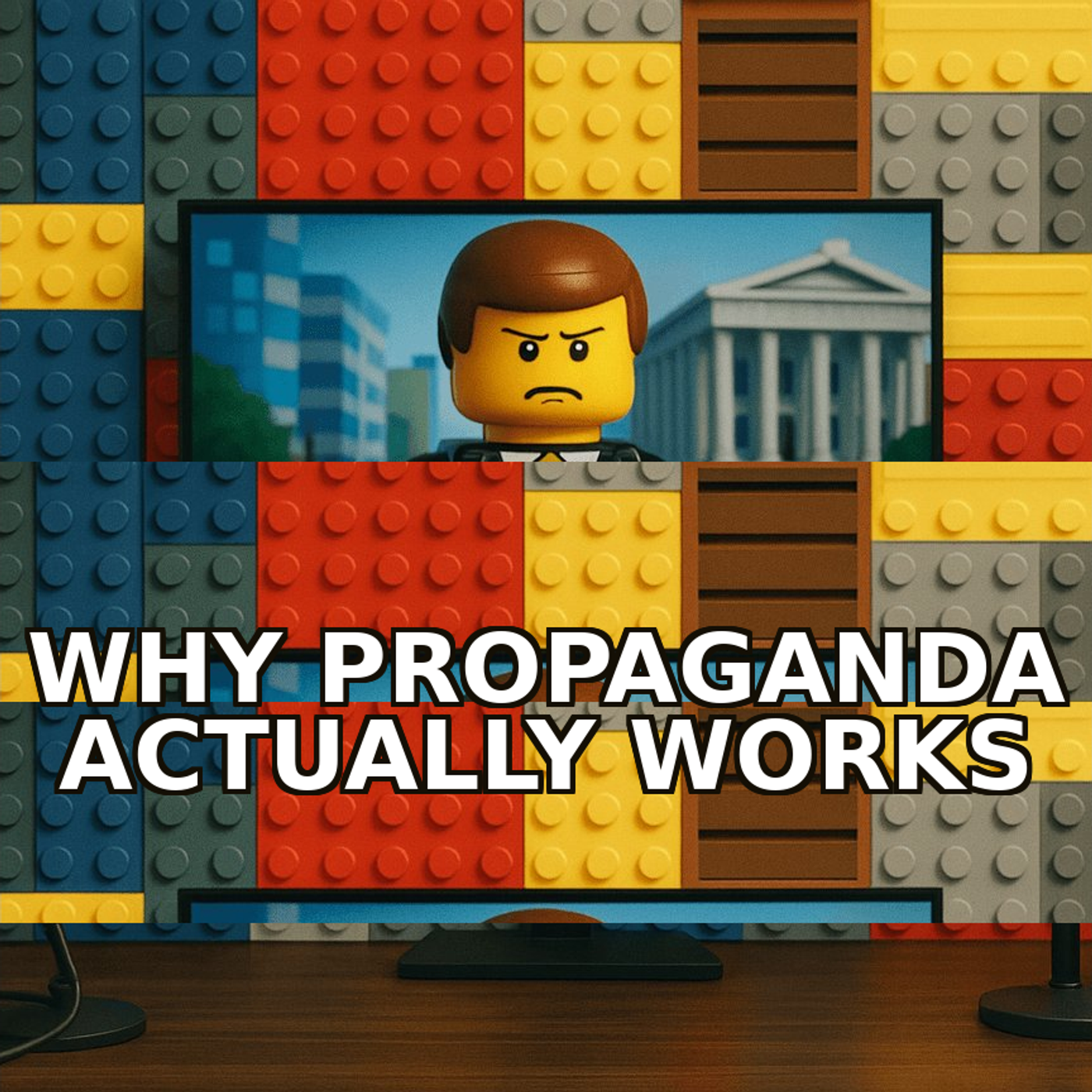
 Iran has a 10-person animation team making Lego-style propaganda videos with hip hop beats that are going viral — and Jeremy, who considers himself reasonably good at detecting BS online, almost shared one before he caught himself. In this episode, Jeremy and Jason dissect how AI-powered slopaganda works: why it's engineered to exploit emotional familiarity, why YouTube is selectively banning it while leaving comparably political domestic content untouched, and what it means when even skeptical, media-literate adults are one tap away from becoming unwilling distribution nodes. If you've ever watched something that felt like news but moved like entertainment and had a nagging feeling you were being played — this conversation names what happened.
Key Moments
- 00:00 — Jeremy discovers Iranian Lego propaganda videos and almost shares them before catching himself
- 01:30 — Jason confirms he's seen them: why YouTube's ban is inconsistent and what it actually signals
- 02:42 — The 'slopaganda wars': how the format compresses political narrative into an irresistible two-minute package
- 05:12 — The Daily Show comparison: why source legitimacy changes how propaganda lands, not just the content
- 07:16 — How Lego nostalgia and great music are doing the persuasion work before the message even registers
- 08:12 — YouTube's stated reason vs. the actual reason: 'spam and scams' as a cover for political compliance
- 13:33 — Jason on Netanyahu, Epstein files, and why the videos' specific claims are getting suppressed
- 15:25 — YouTube as a business making political bets, not a neutral content moderator
- 16:21 — Jeremy on Canada's social media bans for minors — and why this episode made him understand the urgency
- 19:01 — The media literacy takeaway: what to ask yourself before you hit share
Jeremy Grater: All right, so as I was saying. I mean this is just kill like this is taking what we saw in the the transition of news, right? To go from your your your nightly news to the daily show to John Oliver, like making the news entertaining. It's consolidating this down to a two minute amazing music video that is entertaining as hell, dropping a lot of what some would say facts, others would argue not. I I I will I'll let you be the judge. But It's just it's it's so incredibly entertaining and it just drops these lyrics that then are stuck in your head that you then repeat over and over again in your head and it becomes truth and and you share it â with everyone you know because you're so into it. That's how it works.
Jason Haworth: Propaganda. Like it is. And like you said, I don't think this is anything worse than what you would see on the Colbert rapport or the Daily Show. Or I guess it wasn't the Colbert Report, it'd be the late show with Stephen Colbert, which is no longer around. â John Oliver's piece, â you know, last week tonight. Like this is not any worse. But I think it's because It compresses so many narratives into something that's succinct and because the source feels like it's propaganda, it means that it feels less true. And I'm I'm I'm not gonna discount the fact that they're calling out Israel on this as potentially being another reason why they want to clamp this down, because they don't want to create more tension in that area. But I mean, that video straight up calls out the corruption of the Trump administration. Repeatedly.
Jeremy Grater: If i if the Daily Show, if John Oliver, if Stephen Colbert had produced this, it would just be an another funny meme. It would be something that like i is seen as comedy. So â is it the source? Is it because of where it's coming from and and the intention behind it that you think is causing it to be seen as more controversial?
Jason Haworth: I don't know. What is what did the internet say YouTube's justification is? â
Jeremy Grater: â well well YouTube's justification, I'm not sure. I've I've just seen basically the reference that they've they've pulled it down. But
Jason Haworth: Yeah.
Jeremy Grater: It's just curious to me because it's you know, it it's clearly playing playing on â like any good propaganda, something that we have an emotional attachment to. Lego's been around forever. Young people in particular have been watching like these Lego movies for many, many years. That that was sort of after my time. So it it it automatically instills this sense of trust, of familiarity, and the fact that the music is great makes it you wanna listen to it, you wanna hear how they're gonna tell this story â to to this incredible beat. Like it's just so well done. And I I get it. Like if if you know the other reason it works is because it's not just it's not dressed up as news, it's not supposed to be the daily show. It is something where you're not looking for this, you're scrolling, you're looking for cat videos and you know dogs chasing people around or whatever. And then this hits, and you're like, â wow, this looks great. What is this? â my gosh, this is so cool. Share, share, share.
Jason Haworth: Yeah. I mean YouTube's argument, so there there's I found a a Yahoo news article and they literally said we terminated the channel for violating our spam, dissective practices, and scams policies, a YouTube spokesman told AFP without elaborating. And those guys replied the explosive media replied back with seriously, are our Lego style animations actually violent? And it's not.
Jeremy Grater: Right. No.
Jason Haworth: Like this is no more violent than the shit that I see on YouTube. It's no more I this is
Jeremy Grater: How many streamed video games that we see are do we see that are â on YouTube of people like real war scenarios of people playing, I don't know, Call of Duty or whatever? That's that's more violent than this.
Jason Haworth: You that y you w you actually used to be able to see executions on YouTube for a period of time, especially during the first Persian Gulf War. I mean, and there were warning signs and everything up, violent content, be careful. I mean this is horseshit. This is you this is Google sucking up to the Trump administration. Plain and simple. Like there's there's not anything else to really comment on. And I am I shocked? No. Am I disappointed? Sure.
Jeremy Grater: Right. Yeah. Yeah. Yeah.
Jason Haworth: But I mean, disappointment in Silicon Valley these days That's par. I mean, I I just I they're doing stuff to try to keep themselves afloat so the people in office don't take â out. I and some of â are, you know, flat out s trying to influence and pedal their way through this to try to consolidate their power and become more powerful in these scenarios. So these videos are great. They're funny, they're well done.
Jeremy Grater: Mm-hmm.
Jason Haworth: â the messaging is succinct. â I think a lot of it will resonate with a lot of people. It's certain certainly parts of it resonate with me. â you know, I I am offended that we're going to war because this asshole said we weren't gonna go to war and we're going to war over supposed nuclear weapons that they were gonna get that were imminent, but we destroyed everything before. Like it's just it's a bunch of double talk bullshit. And
Jeremy Grater: Mm-hmm. Mm-hmm.
Jason Haworth: the people that are excited before it and believe it are just people they're the ones that Trump's fucking F-15 flying over dumping shit on. They're the ones looking up to the sky going, feed me, â master. I mean that they're a bunch of shit eating fucking morons. You know? Because this is not fucking real, man. Like what what he says is not real. And these Lego videos
Jeremy Grater: Right.
Jason Haworth: Yes, there's there's definitely truth in them. Like there's no doubt that this ad administration and their family members have all enriched themselves in this process and don't give a fuck who they hurt. And if you think otherwise, it's because you're looking up at the jet.
Jeremy Grater: Yeah. This video in particular calls out that eggs that exact thing, the the motivation for this war. And this one, just to just a warning, this one will be stuck in your head. â I just â I this must be the eighth time I've watched this today. Like the the the song is so catchy, I can't help it. But â again, it's it sort of speaks to the motivation. And the other thing that I think is interesting â about this particular â approach that they're taking is that they are very explicitly calling out Trump, right? This is not America. They like even even those behind the propaganda are are able to see this is not America wanting to do this, this is this guy. And and they're calling him out specifically in these videos.
Jason Haworth: Yeah. Yeah. Trying to distract everybody from his name being in the Epstein files. And I I I think the part that they're I guess YouTube gets to stand on the grounds that by saying Netanyahu has the Epstein files and the evidence he can pull Trump strings and made Trump go into Iran. And I it could be a hundred percent true. Great. Release that evidence. Like somebody somebody released some actual evidence.
Jeremy Grater: Mm-hmm. Yeah. Well and and Let him sue them and and prove prove that that's not true. I mean, I don't know. I I haven't been in his office, I haven't seen it they've seen any files, but there's a way to deal with these things and censorship isn't typically it. How much bullshit do we see s from Fox News or how much have we seen from Alex Jones over the years or Candace Owens or any any you can go to MSNBC too? Like they they all are full of shit on some level with whatever propaganda they're trying to push.
Jason Haworth: Yeah, exactly.
Jeremy Grater: It it when you start censoring like we don't like this, we're gonna we're gonna use the excuse of it's too violent when it's a cartoon that is no more violent than every episode of it on Disney Plus, that's bullshit.
Jason Haworth: Yeah. Well, and the the line of censorship, like this is YouTube censoring, so which is allowed. Like they're a private platform and they're allowed to go through and choose what they do and don't put on their platform. Like us. Like they could choose to not put us on anymore. â that's perfectly possible. They could choose to not put Joe Rogan on anymore, they could choose to not let Alex Jones be on there anymore. I mean they have, they've gone through and they've turned off certain â there were parts at a time I think OAN was being through
Jeremy Grater: Yeah. Yeah, of course. Right. Yeah.
Jason Haworth: taken down. So it's not it's not unlike them to turn things off when the heat gets turned up on them. It's just that this particular one, they're taking it down. They took it down really, really fast. And they haven't taken down the ones of the president shitting on the people. Like it's really easy to see that YouTube again doesn't give a fuck.
Jeremy Grater: Mm-hmm.
Jason Haworth: about the American people either. Like that's not their concern. Their their concern is they're a business, they're trying to make money. And this president, again, is open to that.
Jeremy Grater: Yeah. Yeah. Yeah. Th this is all interesting to me in particular living in Canada where the lawmakers are discussing banning social media for kids under sixteen. Right. Like this is something that they're following the lead of other countries around the world that have done this. And again, I circle back to where I started with this, that, you know, I saw this, was sucked in and went like it felt validated in a lot of things that I think, a lot of things that I believe. And I like almost immediately was like, â wow. Like I'm
Jason Haworth: Right.
Jeremy Grater: I consider myself relatively smart when it comes to, you know, bullshit detecting with internet things. And within like 60 seconds, I was like hooked on this thing and and wanting to participate in the sharing of it. And that's the part that's scary, is that you know, I I think of the things that the the decisions that I made in my life because rock stars that I liked, I heard them say something on the radio and I was like, I subscribe to this now too because they're cool. I want to be like them. If I'm a young person today that or or young young-ish and And grew up watching Lego videos and I see something like this and I like the song. Suddenly I'm gonna see what else, what else do they have to say? And I'm gonna dig deeper. And and and again, not that what they're saying is wrong. I, you know, clearly there's some legal question about you know what what they're allowed to say and what they're not, but there's a lot of truth that's there. And so â that's why, know, it's sort of tying that back to your comment about censorship. Like I've always believed that the antidote antidote to bad speech, bad free speech is more free speech. So let this exist and let someone else do better. Why can't someone else do better? The company doing this is a small team in Iran of 10 people. We've we've got some pretty big media monsters here that can can play this game and should be playing it better, and they're not.
Jason Haworth: We do. Well, and and your point about if I'm a young person and I grew up on Legos and I watch this, I'm gonna be more influenced by this and look at these different pieces, that's a hundred percent correct. And y one could actually say that that is the justification for why it is you're gonna allow this content to run because it's got imagery that is specifically designed to target people of a certain age or or a certain but at the same time, you know, are you gonna get rid of like fucking puppets for those of us that grew up a Sesame Street? Like I this is
Jeremy Grater: Right.
Jason Haworth: This is the slippery slope argument is definitely in play here, but I also think that the other side to this that we tend to forget is that â this is not a unilateral thing. Like it's not one side doing this and the other side is not. It's it's this type of controlling of the message in the narrative is i is key to winning the hearts and minds of people. And
Jeremy Grater: Right. Mm-hmm.
Jason Haworth: I don't think the people in charge of the United States are interested in winning the hearts in the minds of all of the people. They're interested in keeping the hearts in the minds of the people that put them in office and wanting to go through and suppress the vote so people that don't agree with them aren't allowed to vote. Like women, for example. That's that's definitely part of this strategy, it seems. So I mean it it it's not
Jeremy Grater: Yeah.
Jason Haworth: Yeah, the videos are funny. They are. And they're done well. And yeah, like they they're very direct. But again, I don't think they're any worse than anything that you'd see on the Daily Show or I and they're certainly not worse than Trump flying over and shitting on the American people. And the fact that that just gets to keep running and gets to keep playing and this gets taken down. I that's
Jeremy Grater: Mm-hmm. Mm-hmm. Yeah. Absolutely.
Jason Haworth: Google's just sucking up to the
Jeremy Grater: Yeah. And so I guess, you know, for me, the takeaway here is just like, as always, right? You know, don't don't just buy into what you see. Like stop and think for a minute before you hit that share button, before even before you hit that like button. What is the underlying motivation here? Like what are they trying to convince me to do? Because I think other than us, everyone's trying to convince you to do something online. I'm just trying to convince you to, you know, listen to the next one.
Jason Haworth: Yeah.
Jeremy Grater: We we like doing this and we want you to like listening to it. That's our only motivation. Yeah. That's a n that's an another â good option. Yeah.
Jason Haworth: Or yeah, or go outside and take a walk. How about that? Yeah. Enjoy nature. Explore the real world. Meet space is a wonderful place.
Jeremy Grater: Yes. And â and often far more entertaining. Maybe not than these videos, but most of the time more entertaining.
Jason Haworth: Most of the time.
Jeremy Grater: â all right. Well, I think that's enough rambling from us for one week. Thanks so much for checking out this episode. If you did listen to this, we did show some of the video on YouTube. So go check out the YouTube video because who knows if you're even going to be able to find any of these by the time you're you're â hearing this. â and if you are watching this on YouTube, feel free to listen. â subscribe on Apple, Spotify, wherever you get your podcast. â you can do that simply by going to probots.me. That's where we'll be back Monday morning with another episode. Thanks so much for being there.
Jason Haworth: Thanks everyone. Bye bye.