Why Every Man Should Consider Therapy Now

Are you struggling with the weight of trying to handle everything alone as a man? Many men today face a crisis of loneliness and disconnection, often waiting until divorce, job loss, or addiction forces them to seek help. But there's a better way...

 Apple Podcasts

 YouTube

 Spotify

 Goodpods

 Overcast

 RSS Feed
Transform your mornings with Loftie: Get a game-changing, phone-free alarm clock and save 20% on orders over $100 with promo code FITMESS20 at WWW.BYLOFTIE.COM.
-----
Are you struggling with the weight of trying to handle everything alone as a man?
Many men today face a crisis of loneliness and disconnection, often waiting until divorce, job loss, or addiction forces them to seek help. But there's a better way forward.
In this episode, you'll discover what healthy masculinity really means, why therapy specifically designed for men is different and more effective, and understand practical steps to break free from isolation and build meaningful connections with other men.
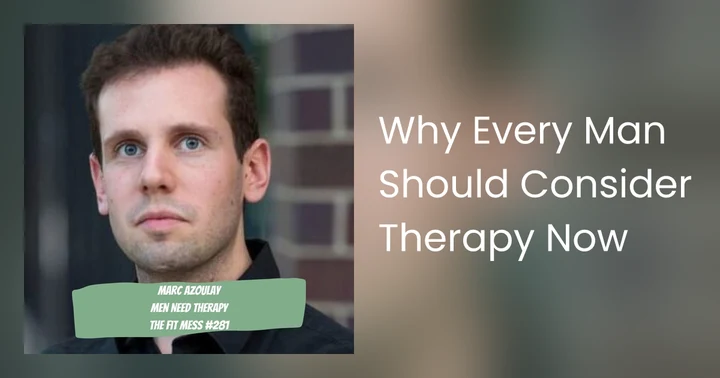
Our guest, Marc Azoulay from Men's Therapy Online reveals the four pillars of authentic masculinity and shares how men can proactively take charge of their mental health before crisis strikes.
Topics Discussed:
- Common barriers preventing men from seeking mental health support
- The current masculinity crisis and finding middle ground between traditional and modern views
- Four pillars of healthy masculinity: strength, courage, mastery, and honor
- How to combat loneliness and build meaningful male friendships as an adult
- Why many traditional therapy approaches fail men
- The importance of having male therapists who understand men's experiences
- Practical steps for getting started with therapy
- How community and group support aid in healing
- The value of proactive vs. reactive mental health care
- Breaking free from the "fix it yourself" mindset
----
GUEST WEBSITE:
https://menstherapy.online/
----
MORE FROM THE FIT MESS:
Connect with us on Threads, Twitter, Instagram, Facebook, and Tiktok
Subscribe to The Fit Mess on Youtube
Join our community in the Fit Mess Facebook group
----
LINKS TO OUR PARTNERS:
-
Explore the many benefits of cold therapy for your body with Nurecover
-
Muse's Brain Sensing Headbands Improve Your Meditation Practice.
-
Get a Free One Year Supply of AG1 Vitamin D3+K2, 5 Travel Packs
-
You Need a Budget helps you quickly get out of debt, and save money faster!
1:40 So I want to just kind of get, you know, a lay of the land. Like, what are some of the common barriers you see that guys are facing getting the mental health that they need? Because, you know, we're in so many positions of power, and yet when it comes to mental health, we are lagging far behind. Far behind, right? I mean, I get too many of the stats, but I can just rouse them off. It's like men commit suicide three times more than women, right? Like one in four men say that they are deeply alone in the fact that nobody would help them in the event of an emergency. You know, we are really struggling with mental health and there's a loneliness epidemic that the Surgeon General published about a couple of years ago, uh, targeted specifically at men and how we don't connect, right? And we are at risk for things like substance use, suicide, domestic violence, things like that.
2:21 So. Yeah, the main issue and this is a shame with men. If I can get one thing across to the guys listening is like come in proactively because what brings guys to therapy is usually a crisis. know, number one that brings them to me is divorce. You know, a guy kind of like getting his losing his family, losing his kids, people losing their job. Number two would be like a big addiction incident, you know, like a binge or relapse. But I think for a lot of men, it takes that like really strong like smack in the face before we even start to think about. prioritizing our mental health. And it's hard at that point. Yeah. we suffer from thinking we can fix everything and it just gets to a point where we realize, okay, it's too far, this load is too heavy, I can't do it.
3:02 Is that the reason? Yeah. of men feel like they have the weight of the world on their shoulders and that they are competing with other guys everywhere. So asking for help is like weak, makes you a pussy, right? And I think also like, and there is value to this, but I think a lot of men do anything else before talking to a therapist, right? They'll try a new diet, they'll try a new exercise, they'll start getting massages, they'll take a new supplement. And I'm all for physical health, but I think guys will do all of that for years before even considering talking to a therapist or. I've talked to a lot of guys that say things like, I don't need some stranger to figure out what's going on. And I think it's quite the opposite. think a stranger is sometimes the best mirror to be held up to show that this is what I hear when you say these things, rather than your mom or your best friend who knows you and all of the stories that you also believe about yourself and can feed into that, right?
3:55 Absolutely. mean, one, we're trained, right? So like any therapist is going to have a master's degree minimum. Many of us have PhDs and we don't have an agenda, right? Like your parents, your friends, your partner, right? They have an agenda. They want the conversation to go a certain way. They want, you know, an outcome that benefits them, even if they're not conscious of that. But with a stranger, it's like, I don't have an investment. I'm on your side. You know, my investment is helping you be more stable and be happier. Yeah, yeah. So I want to talk about one of the key issues you mentioned already, loneliness. Mostly just selfishly, this is something that I struggle with. I recently, I always say recently, it's been almost four years now, I moved to a new town and a new country where I knew nobody. And you know, started working from home. So a lot of those automatic, you know, work friends, not really a thing.
4:39 The after work dinner thing, the party at Bob's house from accounting or whatever, those things don't happen, right? So loneliness is definitely something that I know I struggle from right now. making friends as an adult, very challenging. So where does someone start to unpack and deal with loneliness, particularly as an adult? Yeah, so I think the first thing to think about is what do you want out of other male relationships? A lot of guys don't even take the time to do that, right? And for a lot of us, it's actually not conversation. You know, if you think of like women, they just love chatting. They love, you know, being in touch. They love texting each other all the time. For most masculine dudes, we don't really want that. What we want is companions and camaraderie. You know, so I think like finding a common goal and a common community is critical.
5:22 You know, so I know you talk about fitness a lot. You know, I moved to a small mountain town and I I joined a CrossFit gym and I made a ton of friends that way, right? Because we're kind of, one, we're forced to be together because we work out every day. And two, there's like a common goal there. I think getting involved in volunteer work, nonprofit work can be really great if you work from home or you're a solo entrepreneur. There's a great app that we have in my area called Nextdoor, where some people talk a lot of shit on that, but also lot of people ask for help in the mountains. So like me and my wife, try, was a couple of times a month, it was like go and offer help. We scroll down that and people were like, hey, I need help. With my driveway or I need food or I need child care or like, and we'll just do some of those things just to get into the community a little bit more. Yeah, sounds like it's really tapping into, if you have any, your interests and trying to find other people that are already participating in them.
6:09 Absolutely. Yeah, like take classes, go to courses, go to conferences even, right? See speakers, like just go where other people that are interested in what you are, you know, are around and just make them that way. Because yeah, I think men, we bond through a third activity. We don't do a lot of back and forth talking. We like being, you know, on the same team working towards a Yeah, yeah, You mentioned a term that I think is loaded for some people, masculinity. What does that even mean anymore from your perspective? Yeah, I that could be the whole show, man. think, right? will say masculinity, think, is in a crisis right now. I think there's a lot of really polarized opinions come from all sides of the political spectrum about what masculinity is. But I think when I look at most guys on the ground, a lot of us are just confused.
6:52 We're told to kind of do what's called toxic masculinity, which I don't believe in toxic masculinity, but maybe we'll call it traditional masculinity, which is like, be stoic, don't be a pussy, don't show your emotions, just be kind of like a hard rock. And then kind of this new wave masculinity, which is like, be sensitive, cry, like be open with your emotions, like let people in. And guys hate being that too. Right. So I think like both of those kind of suck. the way that we define it is somewhere in the middle. and really we anchor it around an honor code, right? So if we look at kind of traditional masculine entities, like the armed forces or the Knights of the round table or samurai, right? There was always this honor code and the code that we use at men's therapy online is strength. courage, mastery and honor.
7:33 And I can go through those in detail if you're interested. Sure. So, so strength, I'll run through them really quick. Strength is both physical strength. I think it's important. I think guys feel masculine when they are physically strong, whether that be, you know, being a strength athlete, an endurance athlete, a yoga, whatever, right? But also emotional strength, right? The idea that you can hold heavy emotions or spiritual strength, right? That you can go through really difficult things and keep a spiritual core. You know, I use the example of the idea of being at a funeral. Right. And like being able to give a eulogy that's powerful is an example of emotional strength. You know, not being shut down in the corner, not being overwhelmed by the feelings that are going on there. So building strength, I think is very masculine. The next one is courage, right?
8:15 Pretty self-explanatory, but courage basically is like doing shit that makes that you're afraid of. Right. And again, physical, mental, emotional, spiritual, all of that. There's a great Jocko Willink quote where he talks about Navy SEALs and he says, it's not that Navy SEALs are not afraid. It's that they're able to operate while they are afraid. And I think that's the masculine core. Right. And again, you look at a guy who's courageous and we're like, that's a man. Right. Next one is mastery. Cat crawling around the back. The next one is mastery, which is the idea of like getting good at something. And if you notice how I'm talking about these, they're kind of like abstract themes. It's not about what you're good at. think traditional masculinity, it's like, you've got to be good at like sports or home improvement or weightlifting.
8:56 Where it's like, look, if you're a really masterful baker or even a masterful like crocheter and you're like an artisan, I think that's still masculine, right? The idea of just becoming a master at something, learning, growing, being very technically proficient, you know, just being really good at whatever it is that you want to be good at. know, even if it's a traditionally feminine activity, I think pursuing mastery is the masculine part of it. And then the last one is honor. And that's the one I feel like is lacking a lot in our country, unfortunately, but it's the idea of being ethical, doing the right thing, being a servant leader, treating people right, being honest, having a real honor code and the idea of wanting, kind of the golden rule, treating people how you want to be treated, having that moral core that I think, again, is really lacking.
9:38 And I think a lot of men, when they are acting from a place of honor, they feel really good about themselves. They feel like they're the superhero of the story. For sure. Developing a framework that this takes years and typically some sort of an experience that sent you down this path. So I know you had some issues with the rough childhood, some addiction issues. me a little bit about what got you down this path into helping others. Yeah, for sure. I mean, there's a bunch of story there, but I'll focus it on the addiction because a lot of guys struggle with that, you know, and the cause of my addiction wasn't that I just wanted to get high, right? It wasn't seeking fun. It was kind of like a slow suicide. You know, I was really lost in college. I didn't know what it meant to be an adult, let alone a man.
10:18 I felt like I was really floundering. So I pursued mastery in the forms of getting really good doing drugs. You know, I was selling drugs. It's easy. It turns out, right? It's pretty low barrier to entry. so, you know, I was a party guy, right? I was selling drugs. I felt kind of like pie pie because I was like, had the hookup or whatever, you know? but really it was because I wasn't confident in myself and I was trying to do what I thought, you know, as a college kid, what being a man was, but I was compromising my honor. You know, I was compromising my courage because really I was a coward underneath all that. If I'm being honest with myself, you know, I wasn't building strength because I was using things like drugs to short circuit, you know, certain things like talking to women for instance, right. Or. being confident in social situation with if I wasn't intoxicated, I was just kind of like a weird loser.
11:02 know, I need those things to kind of like pump me up. So I use it to short circuit a lot of stuff. And it wasn't until I got sober, as well as doing a lot of therapy work, I realized, this work is a lot deeper. It's a lot slower than I wanted it to be, you know, and then I really hadn't thought about what it meant to be a man. I really hadn't thought about what it meant to be an adult, what it meant to grow up. So it wasn't until I really started working on those things. you know, intentionally that I start to be happy, you know, and not just feel empty all the time. It's definitely the harder route. I know I still struggle with whether or not I ever had an alcoholic tendency. I come from a long line of proud alcoholics, but I don't know that I ever struggled with it in that way.
11:45 But I definitely use it as a coping mechanism. When the feelings were too much, pour some beer on it and all of sudden the problem went away for a few hours. A lifetime of that, when you suddenly realize there's a better way, probably, so I hear. you start exploring it is it's much harder, it takes much longer, but it's so much more rewarding because I feel like the demons that you're basically drowning, you start to actually remove them from your life more efficiently. Absolutely. Yeah. mean, it's kind of the comparison between eating a bunch of candy, which I think is like the drug and alcohol way, versus like a slow cooked home cooked meal. You know, it takes a long time, but it's much more nourishing for you. I'm curious for you, like what made you want to change?
12:25 Was there like a rock bottom moment or was there something where you're like, oh, this path isn't working? Because I think a lot of guys like stay stuck in that for decades, you know? I definitely was there for a very long time. was mine was a weird. mean, rock bottom is a weird term for it because I was actually already on a path to better. I had I had a really ridiculous knee injury that I started trying to recover from by riding a bike. So I became a bike commuter and in the process started realizing like how much better I felt by exercising. And I actually went to my wife at that point because I was not only was I just physically feeling better. But mentally, having to be so present in the moment of riding a bike through city streets, I was like, God, how do I bring more of this to my life? And so I remember asking my wife, like, you know, this, this is feeling great.
13:06 What should I do? And she's like, I don't know, talk to a therapist. And so I did. And that therapist was very much, on a tended toward Buddhism and taught me about pred meditation and just being present in the moment and all the analogies and all the great stories. And so it just was, it was one of these, like, I had this knee injury and it just. It helped me feel a little better when I started doing one thing, which gave me an idea to try another thing, which gave me an idea to try three more things. And all of a sudden it started compiling to where, at work, when you'd walk by the tray where there's the junk food that everybody brings in from home that they don't want to eat, that I used to grab a handful of, I couldn't even register it as food anymore. was just like, that might as well have been a bag of rocks.
13:47 It didn't look like food anymore. And then I, you know, always looking for a way to get out of work. was like, there's a gym downstairs. So even though I rode to work today, I'm going to go down to the gym for my lunch break and go do that. And so it just like, it snowballed, right? Like once I found the one thing I liked, was, I made me get more curious. And that's really what I think opened up the door to a lifetime of still ongoing change and trying to grow. I like that. I like that it's like, it's gradual too. Cause you know, I'm recording this near the new year and a lot of people just try to like change everything all at once and it just fails. Right? So I like that you're like, it's like one layer at a time. And that's the idea of mastery. It sounds like you like mastered a certain layer and then only at that point, then you're ready to go master the next one and the next one, the next one.
14:27 And before long you're in that kind of like flywheel of self-improvement. So good for you, man. a lot of help too, right? Like it's reaching out because we, again, I think as guys, we feel like I have to have the skills inherent in me to solve all of life's problems. And ain't no way I'm asking anybody for help because that's what some wuss would do and that's not me. But then once you realize, I can literally just ask somebody a question and save like five years of education on this, cool, let's go. I I know. it's like, that's what I think the failing of the older generation is that older men is that they presented complete pictures to us, right? Like either they were the men that we idolized and had everything figured out, or they were the complete loser that were like, I just don't want to be that guy.
15:07 And I think about this dude, right? But like, we didn't get the work in progress. So I think it's cool that you're telling your story of like being a work in progress, because like, I think that's what young men need. I like, yeah, you you know, some things you don't know everything, but like we're trending up and that's, that's kind of what it's all important, you know. think that's, mean, you not to make this about me because you're the guest here, but I mean, that's really what this mission has been about is like, we didn't see the finished product. We kind of have been running from the mess of, you know, the bad example. And so when you're doing that, you tend to find the guy on top of the hill that's finished the journey. And it's so discouraging because you're like, I don't even know, I can't see the path. How do I even get there? So.
15:48 We and I think a lot of guys out there are trying to just be the person around the trail, around the corner on the trail saying, hey, come this way. I see a way up. And that's what we need. We just need more help from each other, whether it is that therapist holding up a mirror when you tell them your story and they reflect back to you what they hear and try to help you find that path forward. Yeah, I like that metaphor. I'm in Colorado, so I love trail and hiking metaphors. And I just want to underline that, you know, again, for listeners out there of like, think a lot of men feel like they're competing with all other men, or it's like them versus the world. I think a lot of our media and social media and influencers like really do accentuate that. But I love your example, because I think there are many men that want to bring you up with them.
16:30 You know, like we're not all fighting each other all the time. And for me, that was a big part of my story was like coming off that kind of like war mentality and just kind of like an entitlement version to it as well of like, it's just me and I gotta fight, you I gotta make it all work. And being like, no, I can ask for help and not only can ask for help, it's like, that's how I make friends. You know, that's how we connect with other people, specifically men is by like learning from them. But I think as a young man, I thought that asking for help means I would be submissive to them, right? They would be dominating me or they would be better than me or smarter than me or they would shame me in some way. There are certainly men that do that, but not all of us. When you went down this path and started taking better care of yourself, to circle back to what we talked about at the beginning with loneliness, did you find it to be a lonely journey?
17:15 Uh, it was, I think in the beginning it was when I, when I made loneliness, you know, I think one of the great things that the recovery community does, you know, I was in AA for about five years is like, kind of healed in a group, you know, I healed with a group of people and I, you know, I'm now in men's groups that I do long-term and I also run, you know, so being in community has always been a big part of my journey and just feeling not so alone and also not so weird. Like it's so nice to hear another guy talk about something and like, Oh yeah, like, like I know something about that. I've been there. Yeah. And not just feel like I'm the most wretched thing on planet Earth. think a lot of people feel that way. Yeah, you know, and it's like, again, that humility piece of like, you know, we're all beautiful snowflakes of problems, right? Like, I think our problems are unique, the kind of the constellation, but each individual problem has probably already been solved by somebody else.
18:02 Yeah, yeah, absolutely. Cool, so tell me a little bit more about your program and what people can do to take part in it. Sure. Yeah. So everything is on menstherapy.online. You know, we're a community focused program building emotional intelligence with guys. We have kind of three things. have individual counseling, which is exactly what you think it is. We're all male therapists. So I think it's important for guys because as men, we want to talk about some of the more brutal experiences that we have. You know, I'm talking about sexuality. I'm talking about like inner violence that we can have the kind of hunter mentality. You know, our emotions can be very violent and intense. And I think Oftentimes women counselors don't get that part of us. They don't get how savage we actually are inside and a lot of men hold back.
18:43 So that therapy is not effective if you're holding back from your therapist, right? So we got that. We got groups. We have general men's groups as well as divorced dad specific men's groups because that is a big population that ends up contacting us. And the last thing we do is we do retreats. So we do wellness backpacking retreats in Colorado and traditional men's retreats in Boulder. So we're kind of wraparound services that way. I want to touch on what you mentioned there about one of the ways that therapy can fail men. Are there other ways that guys, especially if somebody is hesitant, that they're listening to this thinking like, don't know this is for me, let me see what this podcast has to say about it. What other sort of red flags should a guy look for before they head into that therapist's office for the first time?
19:25 A couple right? mean the one question if you're going to ask only one question ask your therapist if they've done their own therapy and for how long and if it's less is surprising. I have therapist friends and my therapist when they say I when I talk to my therapist like the first time I heard that from a therapist, it blew my mind. I was like, no, you're supposed to have this figured out. Why do you have a therapist? Right now? You want them to be experiencing it. You want them to know what it's like to be a client. You want them to have done their own personal work. So I say like minimum five years. If you ask a therapist how long and they're like, I just started or that's not for me. That's something I do for you people. That level of separation is going to create a real entitled therapist, right? The other one, and I think it was more female therapists, is what I call validation therapy, right?
20:08 Of like you come in as a client, You're talking about your pain of the week and the therapist is just like, my God, that's so bad. That's so hard for you. Like it's so tough. That doesn't work for men because we end up feeling like victims and we don't want to be a victim. We don't want some, we don't want a pity party, you know? about the other side of that of, yeah, you and most people, it's common what you're going through. there value in that? Yeah, I think that helps a little bit, right? I mean, it's an art form. in my work, tend to, want to validate a little bit, but men also want solutions, right? They want like, okay, you like told me what's wrong. I understand it. I grok it. I get that from my childhood. Now what? Right. So, you know, longer term therapy, what we do is we have doing kind of like mission based therapy of like, Hey, this is your objective.
20:49 Go out, have that conversation with your spouse, come back, report to me, and we're just going to keep strategizing. So it turns more into coaching. because again, Men want to feel like heroes, not like victims. Yeah, yeah. And for a lot of us, the example growing up was the victim. And so we either mirror it or try to desperately run the other way. Yeah, there's a great AA setting saying which is, a hundred degrees of sick is still sick. Right. So, and I have that in my own life, like trying to just like be anti stuff. It's still fucked up in its own way, you know? and it's hard because when you're running from something, you don't know what you're running to. often, it's just the fear. You're just in that flight mode your whole life.
21:31 Great stuff. Anything important here that we did not touch on that you want to make sure we mention to folks? I think we covered, think it was a great survey. Again, check out men's therapy down online. There's a lot of good stuff there, a lot of podcasts, blogs, all kinds of free stuff to give away. So yeah, if you're on the fence, reach out and talk, you know. In general, that's a good rule. you're not sure, just give it a shot. not? Yeah, that's right. Cool. Mark, thanks so much for your time. We'll make sure those links are in the show description here for this episode. Really appreciate your time today. Thanks so much. Thank

Founder, Men's Therapy Online
Marc Azoulay LPC, LAC, CGP, ACS is the founder of Men’s Therapy Online, a community and healing hub for men who want to get back on their feet or take their lives to the next level. With the help of his team of licensed clinicians he provides ongoing men’s groups, individual counseling, and powerful wilderness retreats to his members. With a background in psychoanalysis, neuroscience, and Buddhism, Marc is able to help men uncover and destroy the unconscious barriers that hold them back. His mission is to help men become the best versions of themselves and truly show up for their lives, relationships, and community.